
Something is happening across Europe’s railways that hasn’t happened in a generation.
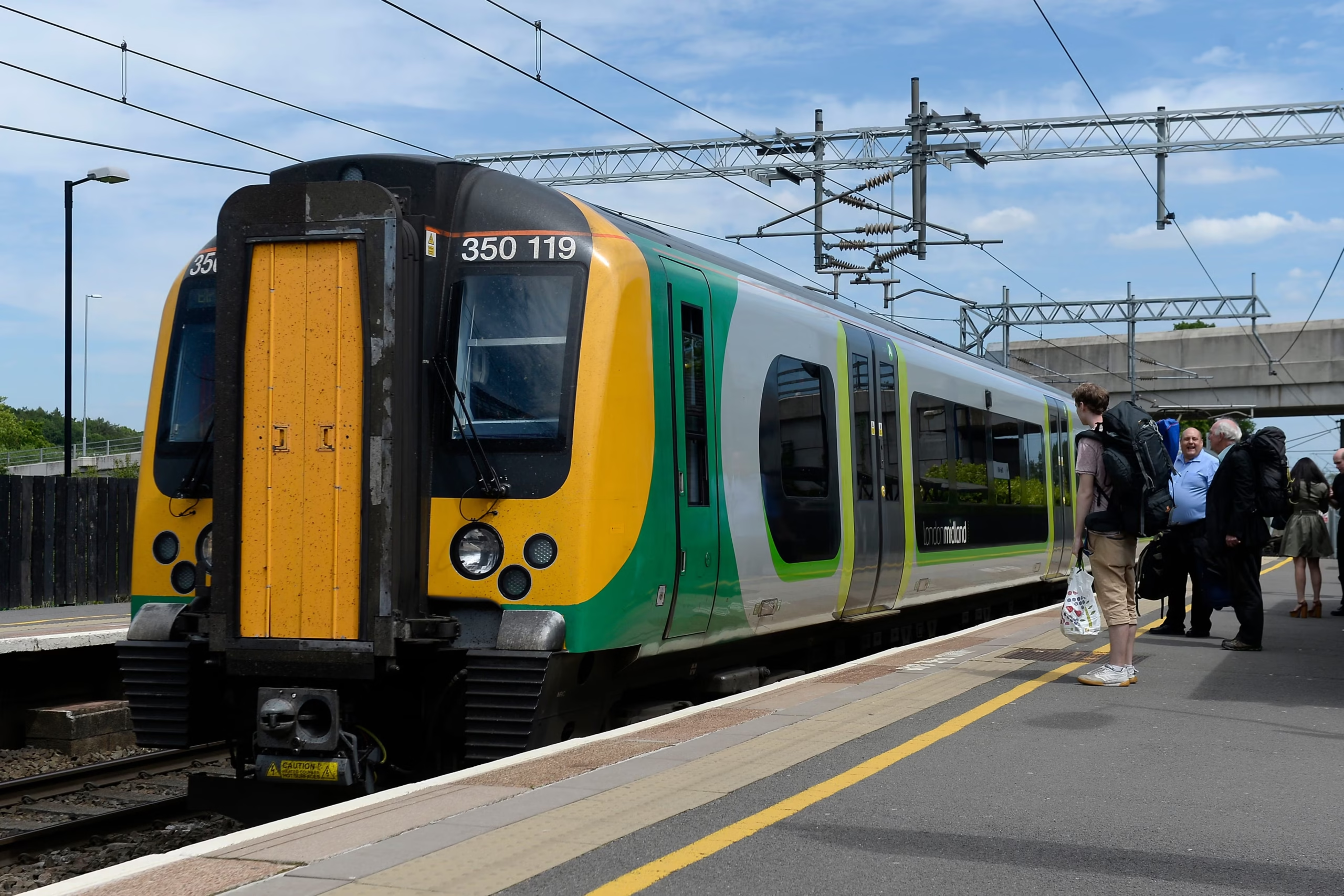
New night trains are launching on routes that haven’t had overnight services in decades. Paris to Berlin by sleeper, revived by European Sleeper in March 2026. Brussels to Milan, starting September. A Berlin to Copenhagen service running on brand-new ComfortJet trains at 230 km/h, with an on-board restaurant, Wi-Fi, and a children’s cinema. Ten EU pilot projects specifically designed to eliminate the cross-border bottlenecks that have frustrated inter-rail travellers for years.
This isn’t a nostalgia project. It’s a structural shift in how Europe moves — and in 2026, booking a rail journey across the continent has become simultaneously more exciting and more complicated than it’s ever been.
The platform you use to navigate it matters more than most travellers realise.

What Omio does — and where its limits show
Omio is tidy. The interface is clean, the search is fast, and for a traveller who wants to see trains, buses, and flights in one place without committing to a specific mode, it’s a logical first stop. It covers 37 countries, handles multi-modal comparisons, and works well for simple, single-country trips where the routing is straightforward.
But tidy has a ceiling. Extensive independent testing across dozens of popular European routes consistently finds the same limitation: Omio struggles with complexity. Multi-leg cross-border journeys — the kind that define real European rail travel — regularly surface incomplete results or miss cheaper routing options that other platforms find without effort. It books flights, which sounds like an advantage until you notice that the flights are often cheaper and more visible than the train alternatives, quietly nudging you toward the mode that generates higher commission rather than the one that gets you there best. And for travellers specifically planning rail journeys, an app that treats trains as one option among several isn’t optimised for what they actually need.
What Rail Europe does — and where its limits show
Rail Europe is the more specialised option. It carries genuine expertise in the pass market — Interrail, Eurail, regional passes — and its CO2 impact data, displayed clearly for every journey, makes it the instinctive choice for eco-conscious travellers who want to see the environmental case for rail alongside the price case.
For Italian itineraries in particular, Rail Europe does something intelligently: it automatically upgrades Frecciarossa segments where first class adds real value and keeps regional connections in second class, a quiet piece of optimisation that saves travellers from thinking too hard about class selection on complicated routes.
But Rail Europe’s pricing on complex, multi-leg journeys frequently comes in higher than it needs to — sometimes significantly. A Paris–Lyon second-class TGV ticket that costs £37.10 total on Trainline costs £38.50 on Rail Europe, with a booking fee nearly 70% higher. Multiply that across a two-week multi-country itinerary and the difference accumulates into a meaningful sum. For rail pass buyers, Rail Europe earns its place. For point-to-point ticket buyers planning complex itineraries, the cost gap is harder to justify.
What Trainline has quietly become
Trainline launched in 1997 as a UK rail ticketing app. What it is in 2026 is something considerably larger: Europe’s leading independent rail and coach booking platform, with 172,000 journeys booked through it every single day, £6.3 billion in net ticket sales in FY2026 — a 7% year-on-year increase — and 30 million monthly active users across its platform.
The numbers matter less than what they represent: a platform that has kept pace with the railway it serves, rather than falling behind it.
In Spain, Trainline nearly tripled its domestic market share compared to pre-rail-liberalisation levels by early 2026, moving faster than any other aggregator to capture the demand created by new low-cost operators entering the market. Italy and France saw over 40% year-on-year growth. The platform’s expansion isn’t just geographic — it’s structural, tracking the liberalisation of European rail services in real time and adding new carriers the moment they become bookable.
For the traveller planning the London-Paris-Amsterdam-Berlin loop that is the defining European rail journey, the alternative to Trainline is four bookings on four national operator sites — each with their own interface, their own glitches, and some of them famously hostile to non-European credit cards. Trainline puts it in one search, one cart, one booking. And on complex routes, independent testing consistently finds it cheaper than both Omio and Rail Europe, often by 20 to 50%.

The features that change how you travel, not just how you book
The platform’s AI integration — rolled out across disruption handling, customer support, and journey management throughout 2025 — means that when your Paris–Lyon TGV runs 40 minutes late and you have a connection to make, Trainline isn’t waiting for you to figure out the alternatives. It’s already surfacing them.
Digital railcards — available directly through the app for UK travel — save a third off most rail fares for eligible travellers and live on your phone rather than a physical card that can be lost, forgotten, or left on a kitchen table in the exact moment it’s needed.
The 2026 night train renaissance is fully integrated. European Sleeper’s Paris–Berlin revival, the new Brussels–Milan overnight, the Berlin–Copenhagen ComfortJet service — all bookable through Trainline, all in one search alongside every other operator on those routes.
And the case for choosing rail over flying in 2026 has never been cleaner to make. Paris to London is two hours and sixteen minutes by train versus four-plus hours door-to-door by air. Roughly 80% fewer CO2 emissions. City centre to city centre. No airport security, no luggage fees on most services, no 90-minute check-in buffer for a two-hour flight.
The train is often the smarter option. Trainline’s job is to make sure it’s also the easier one.
Search your route at thetrainline.com — one search across every operator, the best price on complex routes, and Europe’s rail renaissance in one app.










Related Posts



Stay Informed With the Latest & Most Important News
Previous Post
Next Post











-
 01Essential Camping Gear Checklist for Your Next Outdoor Adventure
 -
 02How to Save More on Flights and Hotels with Trip.com
 -
 03Work Smarter from Home: 10 Home Office Essentials to Boost Productivity
 -
 0410 Essential Features Every Small Business Website Should Have
 -
 05Travel Smarter: Easy Ways to Cut Costs on Your Next Trip
 -
 06Why Plant-Based Food Is Becoming More Mainstream
 -
 07The New Economic Reality: How Rising Living Costs Are Rewriting Financial Planning